Red Nations Rising
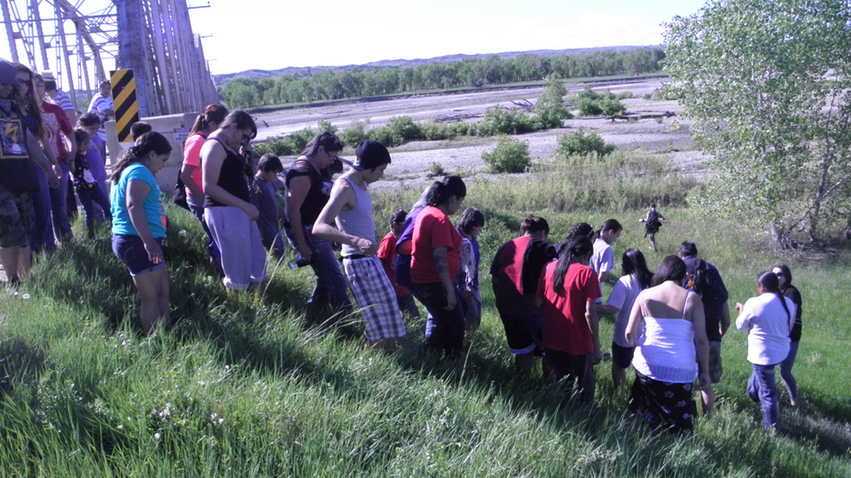
Moccasins on the Ground at Takini on the Cheyenne River Reservation
by Owe Aku International Justice Project
July 1, 2013! In our effort to be true to our principal objective to preserve sacred water�and protect Ina Maka for future generations, working within the protocol of our traditions�and responsibilities must always be our first priority. While journeying through the land�after the Cheyenne River Moccasins on the Ground training, Obama made indications�that he will not approve the Keystone XL Pipeline. That would be a great victory. �However, our victory does not come until all sacred water is protected from tarsands,�uranium mining, coal extraction and the myriad ways fat takers destroy Ina Maka. �
The Moccasins on the Ground Tour of Resistance, in conjunction with many allies and�relatives, was on the move again with more non-violent direct action training on the�Cheyenne River territory of the Lakota Nation from June 14th through 16th. These
educational and informative gatherings are designed to prepare people to protect water�and their communities in opposition to the Keystone XL Pipeline (“KXL”) proposed by�Transcanada currently under review by the Obama administration (the first application
was denied in January 2012).
The Pipeline’s construction is in itself dangerous to communities along the route and the slurrying process is known to be hazardous to ground and surface water. Dozens of�“man camps” will be set up to house the thousands of Union workers imported to run�the enormous equipment used to claw holes in the Earth. These camps are reputed to�bring prostitution, trafficking of women and children, violence, and deaths from�equipment/truck drivers not experienced in operating big haul trucks in isolated areas.�

If the KXL becomes
operational, the
bitumen, which is
what the tarsands oil�is called, must be
heated to over 150
degrees Fahrenheit,
resulting in the KXL
pipes being 16 more
times likely to rupture
than regular crude oil�lines. This is no
ordinary oil. It
contains dozens of
toxic chemicals that are not only used in�extracting oil from the�rock but also in melting the bitumen to force it through the pipes. It is not a question of�whether or not the Pipeline will leak but rather when, where and how much will be�leaked. Tantoo Cardinal, who was introduced by Debra White Plume and is on the�frontline of resistance in her own homeland, talked personally about it:
“I am from the area around the Tarsands mine and I’m here to tell you the water
is contaminated for at least 100 kilometers all around the mine site. We are like
the polar bears who are also being threatened by climate change because the
ice flows they depend on get smaller and smaller; our territory shrinks from
government and corporate assaults by the fattakers and we are left with less and
less.” (Tantoo Cardinal)
The oil spill in Mayflower, Arkansas consisted of tarsands bitumen and to hide the�destruction from the public and media, a news blackout was enforced by militarized�police and national guard while a no-fly zone was enforced to make sure no�photographs of the devastation were released. This is just one of dozens of leaks that�has happened.
The Moccasins on the Ground training in Bridger was on the traditional 1851 and 1868�treaty territory of the Lakota Oyate (called the Sioux Nation by the uninitiated). Treaty�status is recognized under international law as well as by the United States, although�the US government is famous for the ongoing violations to all the treaties it has made�with Red Nations as well as with other nations around the world. The treaties identify�the inherently sovereign land of the Lakota people and preserve that land for Lakota�people to exercise a responsibility for protecting sacred water for future generations. �This is Lakota law and tradition.
“I’m in South Dakota today, sort of a ground zero for the XL Keystone Pipeline,
that pipeline, owned by a Canadian Corporation which will export tar sands oil to
the rest of the world. This is the heart of the North American continent here.
Bwaan Akiing is what we call this land-Land of the Lakota. There are no pipelines
across it, and beneath it is the Oglalla Aquifer wherein lies the vast majority of the
water for this region. The Lakota understand that water is life, and that there is no
new water. It turns out, tar sands carrying pipelines are sixteen times more likely
to break than a conventional pipeline, and it seems that some ranchers and
Native people, in a new Cowboy and Indian Alliance, are intent upon protecting
that water.” (Militarizing Fossil Fuels in the East, Winona LaDuke with Frank
Molley, see http://westcoastnativenews.com/when-drones-guard-the-pipeline/.)
The Pipeline will cross the territory of the Lakota Oyate for hundreds of miles. Not only�does it pass over the Oglala Aquifer, it crosses the Mni Wiconi Project which supplies�drinking water to the Cheyenne River, Rosebud, and Pine Ridge Indian Reservations.
“Our people are suffering way beyond their age. Illnesses caused by poisoned
water and the weight of the trauma from generations of suffering lie under the
sicknesses that plague us. This Pipeline is just one more step in their attempts
to remove us from the land.” (Nina Washtay, Idle No More).
Non-violent direct�action, the right to�assembly and the right�to free speech are all�principles being�employed by Owe Aku�and its allies in an
attempt to take action�to protect sacred water�which goes beyond�proclamations,�petitions and�resolutions. At�Moccasins on the�Ground a National�Lawyer’s Guild�attorney explained that�rights normally reserved under the U.S. Constitution are not only threatened but have�been virtually annihilated. Under the Patriot Act any interference with state, local or�national policy is considered an act of terror.
“Twenty years ago this region was determined to be a national sacrifice area.
You cannot regulate the Pipeline. All you can do is stop it but protection under
traditional law or treaty law will not be from the courts. It’s easy to define legal
rights [for participants] in non-violent direct action: there are none left.”
As evidenced by the tarsands spill in Arkansas and the bombing in Boston, the�militarized police force of the United States does not hesitate to use police-state policies�to protect the corporations. The training of Moccasins on the Ground is designed to�instill discipline and a sense of responsibility in strategies for stopping the pipeline�through the return of traditional values and decolonization. The balance between
speakers and hands-on training is what makes Moccasins on the Ground so effective.�As explained by several of the elders present, this is a spiritual movement based in the�ancient Lakota tradition of relationships between human beings, plants, animals, water�and rock. In talking about a ceremony that closed the three-day training, Rocky Afraid�of Hawk explained that:
“We are not allies. We are relatives. Allies may be together, but still apart. In the
Lakota way, relatives are with us. The Hunka ceremony (the making of relatives)
is not about individuals but about tiyospaye (the extended family). This is the
way we should think about what we are doing and how we should conduct
ourselves to always be good relatives with each other and the water.”
Representatives of many Red Nations including the Nakota, Dakota, and Lakota�peoples, Northern Cheyenne, Dine, Anishinabe, Cree, along with representatives from�Protecting the Sacred, Tar Sands Blockade, Tar Sands Resistance Movement, Utah�Tarsands Resistance, Lakota Media Project, Prairie Dust Films, Idle No More, and�Colorado AIM, Barrio Warriors, and many other organizations, all participated in the�event as well as the Hunka ceremony. �A water ceremony was held along the Cheyenne River, Lakota families from the�Cheyenne River Sioux Tribe made their vow to protect their water and their people from�the KXL. �